It's one thing to read fictional stories. It's quite another to actually write your own fictional work as third graders soon found out during their recent reading unit, featuring narrative writing. However, as you will soon see, success was achieved, following a month's worth of hard work and the necessary literary instruction!
As part of this unit, students continued to pay due diligence to the importance of plot and its five primary elements, including the required rise in action en route to solving any story's central problem. At the same time, they also engaged in studying the different parts of speech and how those specific components then translated into actual word choices, especially with respect to description writing. The exact same sort of writing needed for this unit's own narrative writing Photocard Project.
In addition, students also learned the difference between "showing" verses "telling" when writing, and that it's almost always far better to "show" than it is to simply "tell". The importance of dialogue as a means of "showing" was examined, too, with demonstrations on the proper use and placement of quotes within their own work. Instruction was also provided with respect to the correct usage of quotation marks as well.
However, as is almost always the case, it was the study of figurative language that really grabbed and held the third-graders attention. Their fascination with any, and really all, of the seven forms of figurative language--simile, metaphor, personification, alliteration, hyperbole, idiom, and onomatopoeia--is clearly evident in terms of recognition when read but also, as you will soon see, within their own personal writing.
After scrolling through what once was a collection of old Christmas cards that have since been transported onto the iPad, each student was asked to choose a card that somehow inspired them in some way, shape, or form. They were then asked to write a narrative story centered around the picture on their given card of choice, making sure to use all of the points of study mentioned above. Not only were students able to gain a better understanding of the writing process itself, they were also able to acquire valuable first-hand working knowledge regarding the importance of the editing and rewriting processes as well. Once completed, each third-grader's work was then published using the Photocard app.

Thursday, March 17, 2016

"Plotting" Right Along...
Whew, January just seemed to fly right by, as did our month-long reading unit, featuring the study of story plots. And who better to help students with that than world-renown British children's author Roald Dahl, whose lifetime wealth of work includes the following title selections: Charlie and the Chocolate Factory, Fantastic Mr. Fox, George's Marvelous Medicine, James and the Giant Peach, Matilda, The BFG, The Twits, and The Witches. All read and enjoyed by our third-grade students throughout the month in conjunction with their examination of the five elements of plot itself--exposition, rising action, climax, falling action, and solution.
Once familiar with these core principles and how they actually pertained to the works of a master storyteller such as Dahl--who lays claim to over 200 million copies in print--students were then asked to apply their own knowldege of plot in another way. Using "Google Search", each student was asked to find images that represented all five of the aforementioned components of plot. After locating all of the needed visualizations, students then chose between one of two apps--Animoto or Adobe--to create individual plot videos.
Once familiar with these core principles and how they actually pertained to the works of a master storyteller such as Dahl--who lays claim to over 200 million copies in print--students were then asked to apply their own knowldege of plot in another way. Using "Google Search", each student was asked to find images that represented all five of the aforementioned components of plot. After locating all of the needed visualizations, students then chose between one of two apps--Animoto or Adobe--to create individual plot videos.
Wednesday, January 27, 2016
History Comes Alive at Sleepy Eye Elementary!

Such was the scene on January 8th at Sleepy Eye Elementary's annual Third-Grade Wax Museum--a one-day event culminating the end of the students' biography/autobiography genre reading unit. A core curriculum exercise that required each third-grader to use a wide variety of media sources in order conduct research on their chosen topic person. Once the actual investigative portion of the process was completed, students then assembled their notes, turning them into a well-crafted speech written from the first-person point of view.
According to all who attended--including school staff, fellow students (K-12) as well as family and friends--an excellant job was done by all. Way to show your Sleepy Eye Pride third-graders!
Wednesday, December 23, 2015
Tis the Season of Giving!
 The holiday season marks a time to give and receive gifts. We all know the exhilarating feeling we get when we run down to the tree and see that Santa has made his annual deposit of gifts. We rip into them, hearts racing...beaming smiles lighting up the room. Sometimes we seem to forget however that there are some people in this world that are less fortunate than we are. In fact, some of those people may be our neighbors and friends. That is why at Sleepy Eye Schools we make it a priority to give back by holding an annual food collection appropriately titled "The Giving Tree." The collection simply entails spending the entire month of December collecting food items to be donated to our local food shelf. Through the collection, we help to teach the importance of generosity and being selfless toward others. If you ask your child they should know what those terms mean as we discuss them often in class...especially this time of year.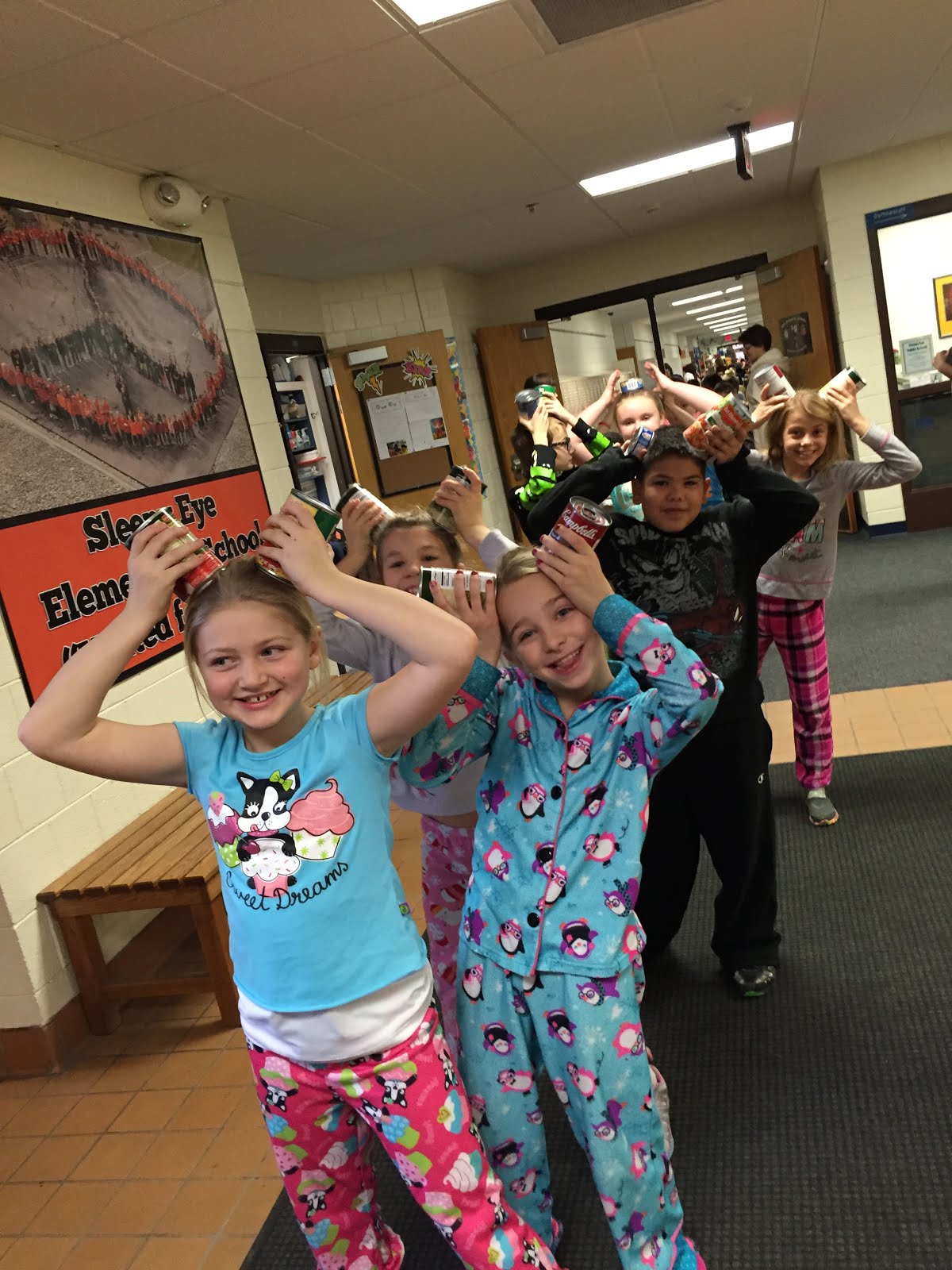
Giving to the Giving Tree is a fun and rewarding experience for all students and one that we celebrate. As a way to reward students for all their hard work and generosity, we hold a party in the gym where we sing karaoke to popular Christmas carols while also enjoying the company others. This year we collected over 1,040 items to help feed our community through the holiday season and beyond. What an excellent way to close out 2015 and usher in the new year.

Merry Christmas everyone! Have a safe and enjoyable holiday season!
Amazing Auras Make Santa Come to Life
As you can see from many of our posts, technology is a huge part of the learning process in our third grade classrooms. The project featured in this next post is no exception. Each year, as a part of our writing curriculum, we write persuasive paragraphs to go along with Santas that were disguised as a part of a family project given over Thanksgiving break. However, just displaying our writing and Santas for all to see was not good enough. We instead decided to make Santa jump off the page...and not just through our amazing writing skills but through the use of technology! For this particular project,
we used multiple apps to achieve the end product. This is a technique called app smashing which allows us to bring a
one-dimensional, paper image of Santa to life.
As stated above, students
were first asked to disguise a printed-form of
Santa in a way that he wouldn’t be recognized as himself. Once we’d
finished
with our decorations and/or embellishments, we then learned about
persuasive
writing, with each student writing a persuasive paragraph to convince
their
reader that their colored image of Santa was, in fact, not Santa. Next,
we
applied an app called “Yak It” in order to make our disguised Santa
figures
talk. The video outcome of this was then created as an overlay to their
actual
Santa image, using the “Aurasma” app. When engaged with this particular
app,
each individual Santa was brought to life, speaking to the listener as
he—the
disguised Santa—presented his argument, in the voice and written words
of its corresponding paragraph author—as to why he is not the actual
Santa but, in reality, someone
else!
Click on the clip below to see the outcome.
Click on the clip below to see the outcome.
Exploring the Lunar Cycle with Stop Motion
As a part of the third grade science curriculum, students spend a considerable amount of time studying our solar system. Among the things in the solar system that they study is the moon. Students are required to know many things about the moon including how it gets its light, how it moves around in our solar system and probably the most difficult to understand they need to know about the Lunar Cycle. Not only do students need to know that our moon looks a little different each night, but they also have to know each phase and must be able to explain how and why this phenomena occurs.
As you can probably imagine, this is a very difficult concept for students to grasp, especially since it is not something that they can readily observe. This is why we make it observable! In class we created a diorama containing the Earth, Sun and the Moon. The Earth (a globe) sat in the bottom of the box. The Sun was simply a flashlight that was stuck through a hole in the side of the box. Finally, the moon was a styrofoam ball on a string. Using the box and these three objects, students were able to explore the interaction that happens between these objects as they move throughout the solar system...specifically as the Moon orbits the Earth.
As if viewing the phases as we moved our Moon around the box wasn't enough, we decided to enhance our experience using technology. Not only did students perform the actions necessary to make the Lunar Cycle observable, but as we moved our Moon, we also took pictures of each phase. When we had completed these pictures we put them together in an app called iStopMotion where we created a stop motion film displaying the phases of the lunar cycle in a continuous stream. All of these actions helped solidify the students' understanding of how and why the lunar cycle occurs as well as their knowledge of the phases themselves.
Click below to view a sample of our stop motion film and see the phases in motion.
As you can probably imagine, this is a very difficult concept for students to grasp, especially since it is not something that they can readily observe. This is why we make it observable! In class we created a diorama containing the Earth, Sun and the Moon. The Earth (a globe) sat in the bottom of the box. The Sun was simply a flashlight that was stuck through a hole in the side of the box. Finally, the moon was a styrofoam ball on a string. Using the box and these three objects, students were able to explore the interaction that happens between these objects as they move throughout the solar system...specifically as the Moon orbits the Earth.
As if viewing the phases as we moved our Moon around the box wasn't enough, we decided to enhance our experience using technology. Not only did students perform the actions necessary to make the Lunar Cycle observable, but as we moved our Moon, we also took pictures of each phase. When we had completed these pictures we put them together in an app called iStopMotion where we created a stop motion film displaying the phases of the lunar cycle in a continuous stream. All of these actions helped solidify the students' understanding of how and why the lunar cycle occurs as well as their knowledge of the phases themselves.
Click below to view a sample of our stop motion film and see the phases in motion.
Sunday, December 6, 2015
Star Light, Star Bright: Dazzled by the Stars
 It may be hard to imagine, but a mere two hours away from school, it is actually possible to lie back in the comfort of a padded, reclining chair, and simply drift away in complete and utter silence, under the soft light of a perfectly projected image of the night sky. Such was the experience of the third graders last Wednesday (December 2nd) whose recent road trip landed them in Marshall, MN, at Southwest Minnesota State University's very own on-campus planetarium.
In addition to our overall viewing of our own nighttime sky as it normally appears, students were also privy to a special treat which involved an in-depth look at the many constellations visible long after the sun has gone down, including those normally seen from our own backyards as well as those we are unfortunately unable to from present geographical location as a result of the sun. Students soon learned that the one constellation most easily seen and located in our own home is "Orion", with his belt made up of three stars all lined up in a row. Additionally, students were also instructed on how to find both the Big and Little Dippers, using the North Star as their guide to finding the former.
 Once we had completed our exploration of the stars themselves, students viewed a short movie, which fell into the mystery genre and featured our very own solar system. A very nice tie in to the conclusion of our recent "Sun, Moon, Stars" science unit. Following that was the holiday laser show, which is always a huge hit with the students. Then, after a quick school-packed lunch, it was off to visit the university's Museum of Natural History where student were encourage to an unique hands-on experience, investigating and manipulating the various displays exhibited.
Not a bad way to spend midday on a windy Wednesday morning, especially with everyone's Sleepy Eye Pride so very pleasantly displayed! Nice job third graders!
Subscribe to:
Comments (Atom)